How Aggressively Should Brands Negotiate Creator Rates?
What offers to 10,000 creators reveal about acceptance rates, counteroffers, and negotiating for better campaign performance.

Leon Lin
Co-founder & CEO
Oct 12, 2026
•
7 min read
Overview
How aggressively should brands negotiate creator rates?
Last year, we published the industry’s most comprehensive report on creator asking prices. Today, we are sharing best practices for creator negotiations. Creator asking prices are generally negotiable, so we want to outline what constitutes a reasonable counteroffer.
In this report, we examined offers sent to 10,000 unique creators through 1stCollab and tracked how creators responded.
How Often Creators Accept Offers
First we wanted to present the data:
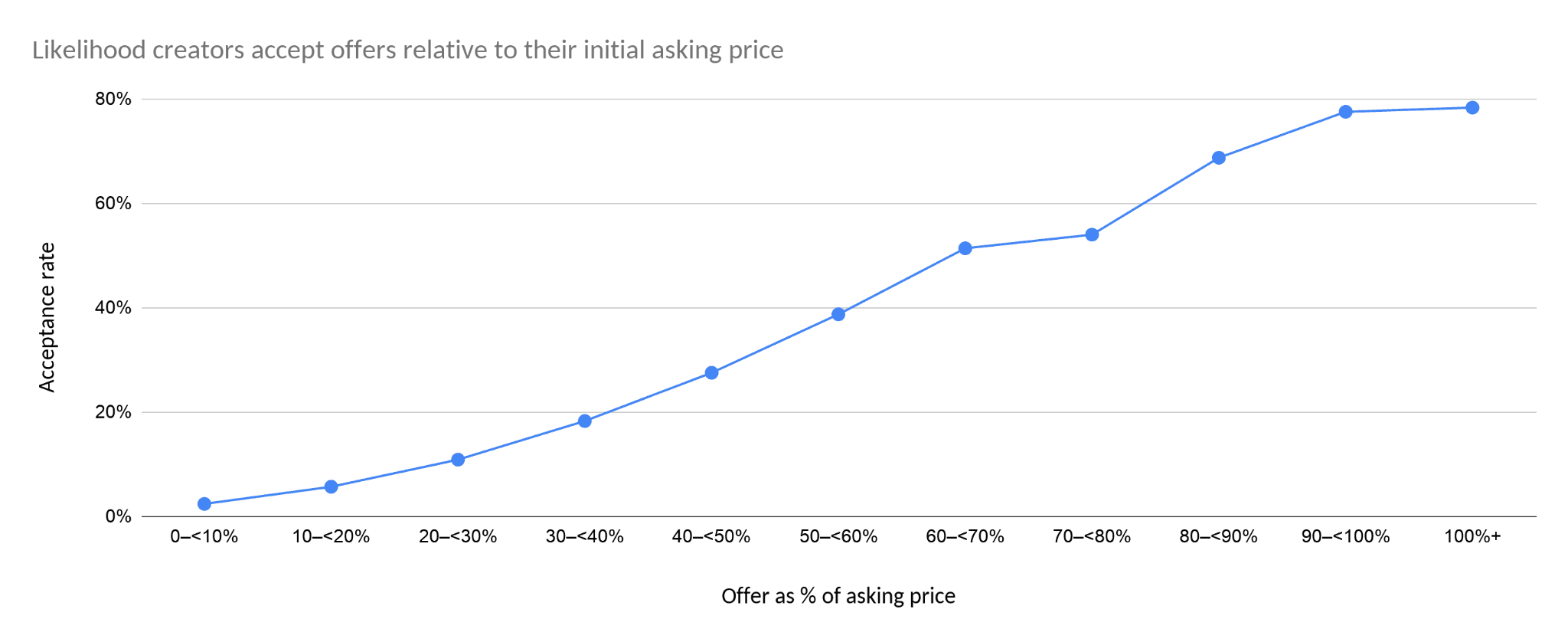
This chart illustrates how often creators accepted an offer as a percentage of their initial asking price. For example, if a creator asked for $1,000 for an IG Reel and TikTok video and a brand offered $500 for the same deliverables, that was categorized as an offer at 50% of asking price. A few key takeaways from the data:
To hit a 50% chance of creator acceptance, brands typically need to offer around 60% of the initial asking price.
A 10% discount off asking price yields almost no drop in acceptance compared to paying full price.
Offers below 30% of asking price have less than a 10% chance of immediate acceptance. However, many creators will still send a counteroffer.
Two sharp drop-offs in acceptance occur: one between 70% and 80% of asking price, and another between 50% and 60%.
Two follow up questions you might have about the data are:
Do creators get offended by lowball offers?
While some creators disengage after receiving low offers, it happens less often than many brands fear. In fact, here are real examples of low offers creators accepted through 1stCollab:
$100 asking, accepted $20 offer for a TikTok Video
$2,000 asking, accepted $100 offer for a TikTok Video
$2,500 asking, accepted $200 for an IG Reel and TikTok Video
$5,500 asking, accepted $550 offer for an IG Reel and TikTok Video
$40,000 asking, accepted $1,000 offer for a TikTok Video (!)
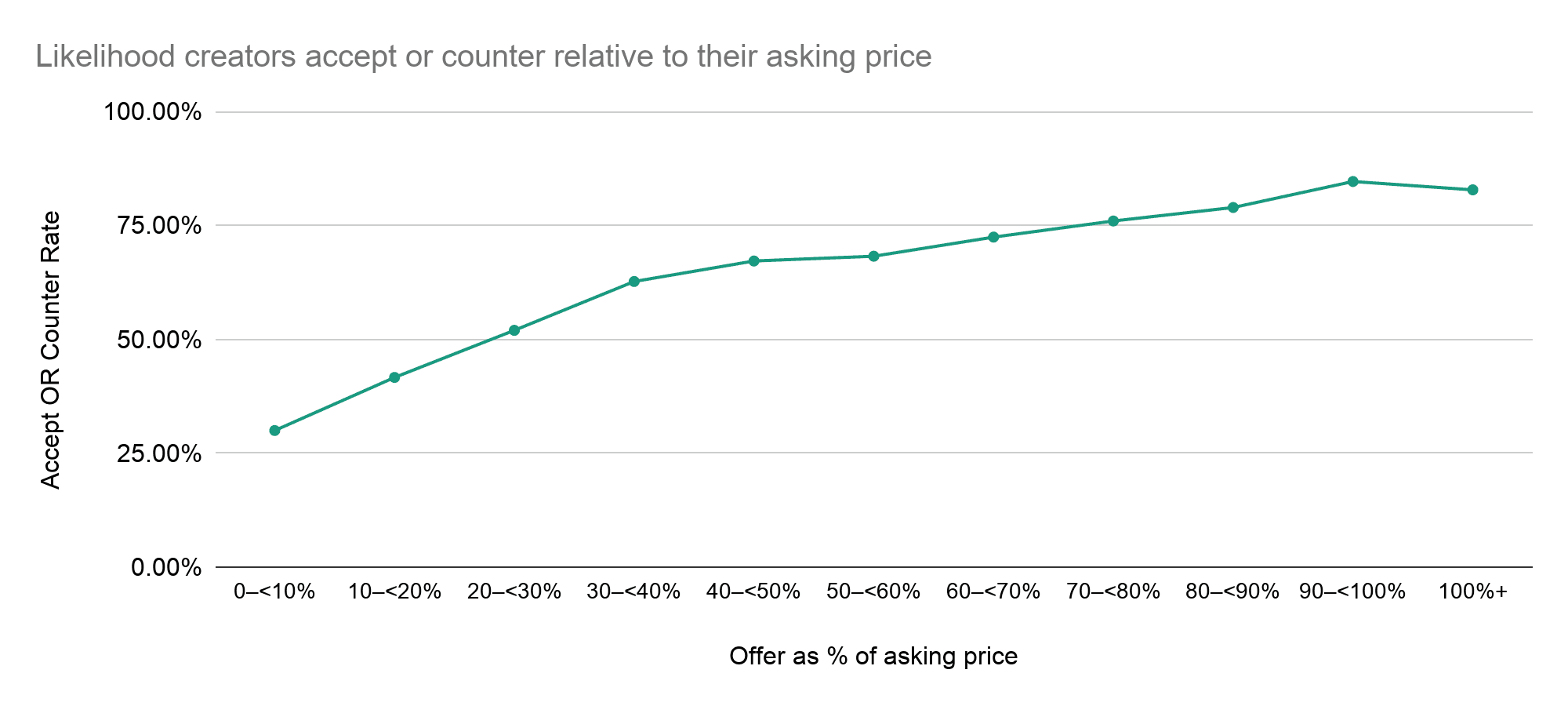
Our data shows that creators frequently counter even when an initial offer is well below their asking rate. The chart below illustrates response rates (acceptances plus counteroffers) across initial offer ranges.
Key patterns from the response data:
Response rates remain high across almost all offer ranges. At 50% of asking price, creators still respond with an acceptance or counteroffer over two-thirds of the time.
At 30% of asking price, direct acceptance is around 10%, but the overall response rate (including counteroffers) is over 50%.
For brands concerned about alienating creators, response rates also provide a proxy for drop-off. For offers at 10% to 20% of asking price, 42% of creators still accept or counter—meaning up to 58% disengage entirely.
We recommend brands negotiate to optimize performance, but we generally suggest offering at least 40% of asking price to keep creators engaged in the negotiation process.
Why don’t creators accept when you give them their asking price?
Even when brands offer 100% of asking price, about 20% of creators do not move forward. Common reasons include:
Delayed creator responses. Creators may reply after campaign budgets are fully allocated or after campaign windows have closed.
Slow brand follow-ups. Delays in countering or confirming can lead creators to update rates or take other deals.
Increased creator demand. Creators receiving multiple full-price offers may raise their asking rates mid-negotiation.
Contractual disagreements. Disagreements over usage rights, exclusivity, or payment terms can stall deals late in the process.
How Acceptance Rate Changes with Creator Price
Should your negotiation strategy change based on the creator’s asking price?
Yes. More expensive creators generally negotiate more firmly. Here is how acceptance rates compare across rate tiers:
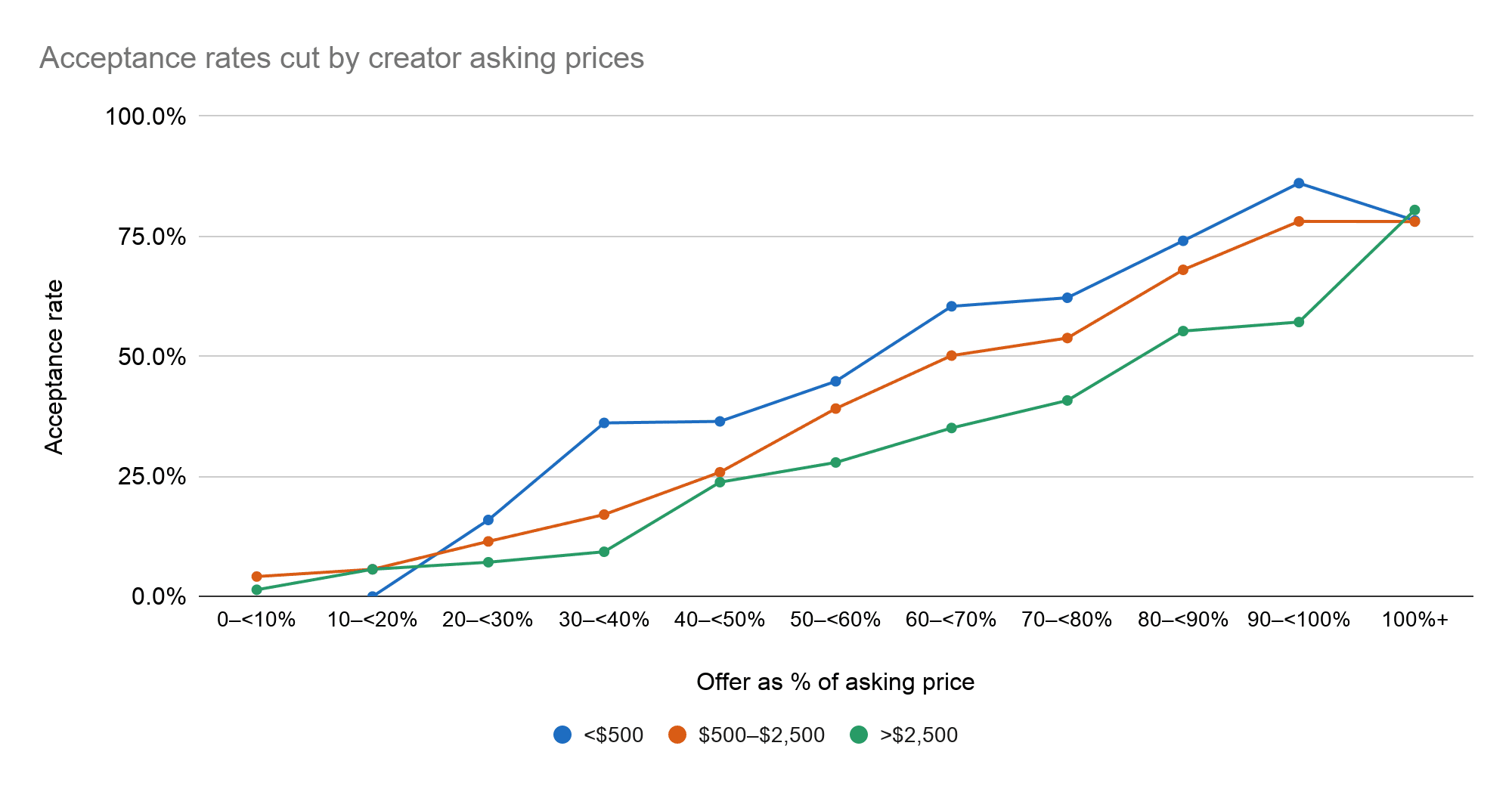
This breakdown groups creators into tier buckets based on initial asking price (for example, a $2,000 asking rate falls into the $500–$2,500 group).
Higher-tier creators are much less likely to accept discounted offers. Across all tiers, acceptance converges around 80% when brands meet the full asking price. However, at a 10% discount (90% of asking price), creators under $2,500 maintain high acceptance, whereas creators over $2,500 drop from 81% to 57%. Below 80% of asking price, acceptance for creators over $2,500 falls below 50%.
Higher-priced creators often have representation and more inbound brand interest, making them less willing to discount. Lower flexibility on rate discounting may also contribute to why larger creators can show lower campaign ROI than smaller creators.
How Frequently Creator Rates Change
When re-engaging a creator for a new campaign, how long can brands expect the creator’s prior rates to hold?
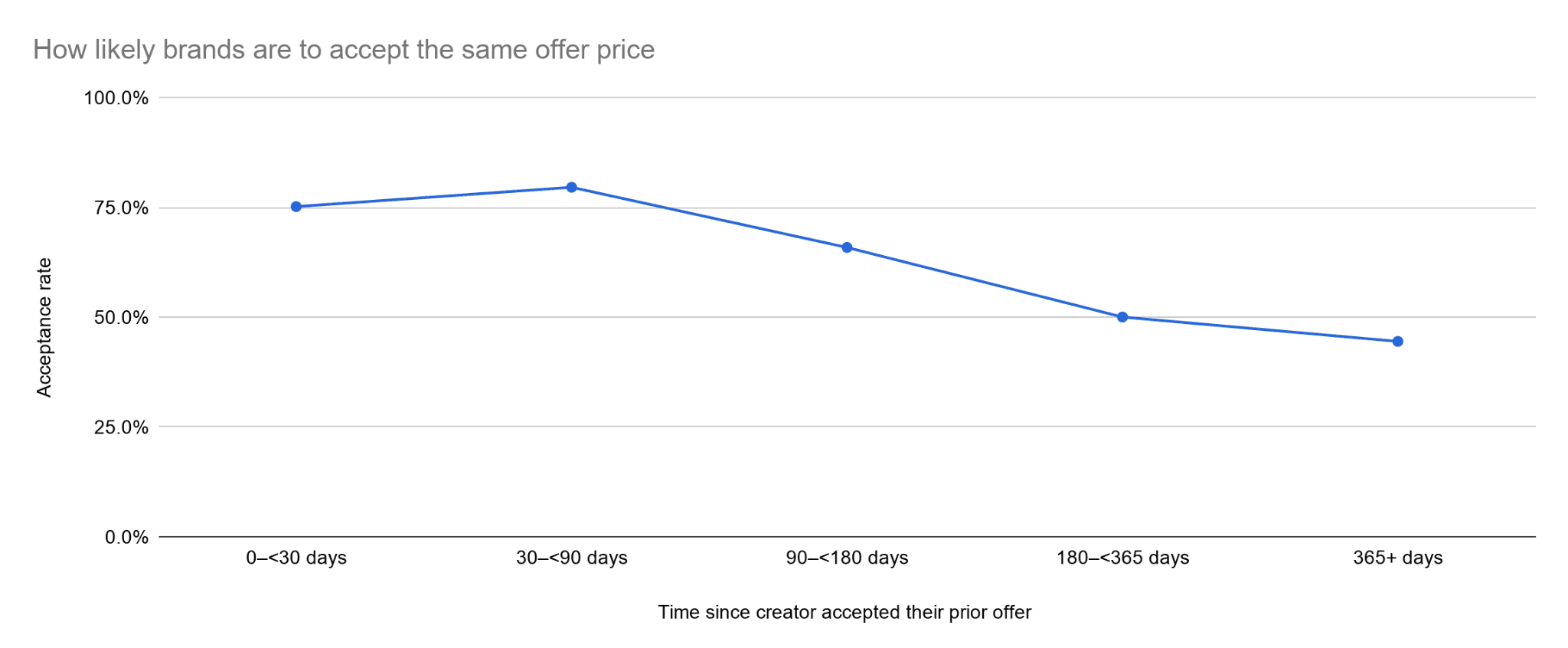
This chart tracks acceptance rates when brands re-offer a creator the exact same rate for identical deliverables over time.
Key findings on repeat pricing:
Within 90 days, creators are highly likely to accept repeat deals at prior rates (with peak acceptance in the 30-to-90-day window).
After 90 days, acceptance drops steadily—from ~80% within 30–90 days to ~50% at 180 days. To lock in strong creators at established rates, re-sign them within 1 to 2 months of an initial campaign.
How to Get the Best Creator Rates and Optimize Performance
Brands can use negotiation data to improve campaign efficiency in two core ways:
Expand top-of-funnel outreach to enable stronger negotiation leverage
To contract 50 creators while target-offering a 25% discount off asking price (a range with ~60% creator acceptance), a brand needs to send roughly 84 offers. Assuming a 1/3 rate-submission rate from initial outreach (per our response rate benchmark data), the campaign requires contacting approximately 250 creators.
Of course, you’ll want to adjust your negotiation strategy based off a few factors:
Niche size. Broad categories (e.g., general lifestyle) allow aggressive negotiation because replacement creators are abundant. Highly specialized niches (e.g. underwater basketweaving) require offers closer to asking price to maintain high conversion.
Timeline constraints. Aggressive negotiation increases counteroffers and rejections, requiring more coordination hours and longer turnaround times.
Budget and volume targets. Smaller budgets demand tighter price controls per creator, whereas larger scale targets may require softer negotiation to secure high creator volume quickly.
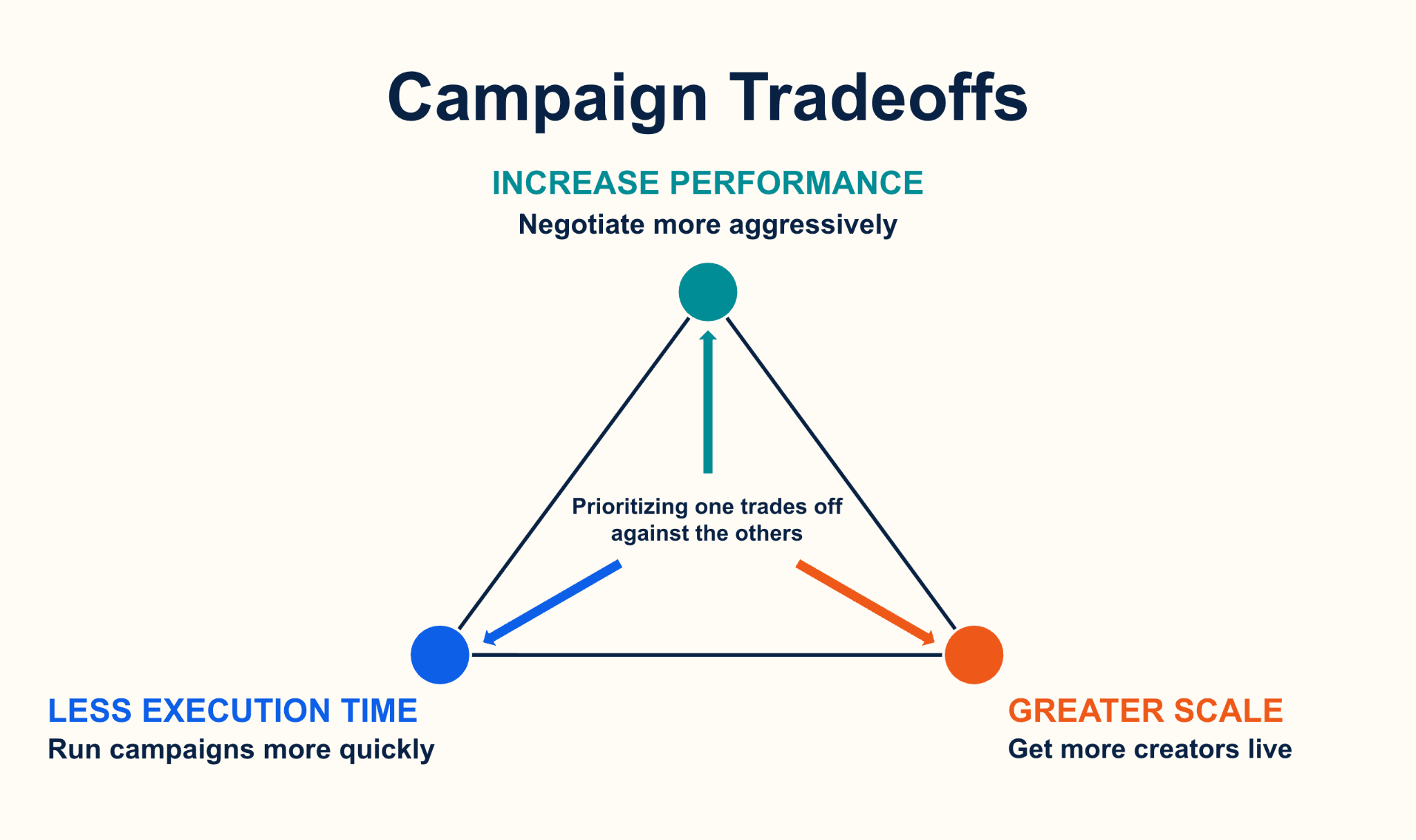
The tradeoffs with running a campaign can be summarized by this graphic:
In summary:
Prioritizing efficiency/ROI requires negotiating more firmly and sourcing a larger creator pool.
Prioritizing speed means offering closer to asking rates to reduce back-and-forth.
Prioritizing total scale increases both management overhead and average talent cost.
Ignore creator asking prices and price predicted engagement instead
Most campaign managers anchor negotiation to creator asking rates or follower counts. We recommend anchoring offers to expected performance metrics instead.
Consider two creators applying to the same campaign:
Creator A | Creator B | |
|---|---|---|
Initial Asking Price | $1,000 | $2,000 |
Follower Count | 500k | 2.2M |
Median Views | 20k | 30k |
For an awareness campaign targeting a $25 CPM, expected view count—not asking price or follower total—should determine target contract value. Using median views as an estimate, a brand should target a $500 payout for Creator A and $750 for Creator B. Based on our negotiation benchmarks, a $500 offer to Creator A (50% of asking) carries a ~39% acceptance chance, while a $750 offer to Creator B (37.5% of asking) carries a ~17% acceptance chance.
Whether optimizing for views, clicks, or conversions, set target rates based on expected performance and use acceptance benchmarks to plan required outreach volume.
We’ll publish more information on how to predict creator engagement in a future blog post, so stay tuned for that!
How 1stCollab helps you optimize performance
1stCollab puts these best practices to work for your brand:
Reach more creators. Negotiate better rates. Our platform automates sourcing, outreach, and negotiations, helping you scale your campaign without adding headcount or spending more time coordinating with creators.
Base your offers on expected performance. We use your campaign goals and proprietary data from hundreds of thousands of creator partnerships to recommend what to offer. That includes how creators perform and how reliably they deliver, from driving conversions to meeting deadlines.
Let’s talk about how to make your next creator campaign more effective.
The Data
This dataset reflects offers sent to 10,000 unique creators on 1stCollab across 100+ brand campaigns spanning TikTok, Instagram, YouTube, and LinkedIn.
Our Negotiation Process
1stCollab campaign negotiations follow a standardized sequence:
Creators apply to a campaign with initial package pricing.
Brands accept or submit a counteroffer.
Parties negotiate until an agreement is reached or negotiations close.